Tag: homepage

  • Reflections on Digital Humanities and Ethnic Studies from CSU Stanislaus

    Reflections on Digital Humanities and Ethnic Studies from CSU Stanislaus

    I was first introduced to members of the Digital Humanities at California State University (DH@CSU) Consortium by a colleague at California State University, Stanislaus, who was leaving our department to pursue a Ph.D. Despite having participated in a workshop that was sponsored by the Digital Ethnic Futures Consortium on how to utilize online programs to make learning more comprehensive for students, I did not know what to expect when I accepted my colleague’s invitation to learn more about the Digital Humanities at DH@CSU.

    In my first meeting with them, I felt out of place because all of them knew each other and they were confidently expressing their expertise, providing keen details about their ongoing tasks. It was not until I asked the facilitator (Katherine D. Harris) about the purpose of the group that I became interested in learning more about them. As I asked this question, I felt that the members took a brief pause from their routine and attentively listened to her explanation of why the group had been created in the first place. Immediately, I felt a strong connection and knew I wanted to be a part of the group. Part of the reason for the DH@CSU Consortium is not only to explore the intersection between the Digital Humanities and Ethnic Studies, but also to create a network among faculty and staff across the California State University system.

    Whilst I am limited in my knowledge about the Digital Humanities, I am an Assistant Professor of Ethnic Studies, and thus, bought into the vision and mission of the DH@CSU Consortium. As a Chicano who is part of the largest ethnic minority in the United States, it is vital to partake in community engagement and focus on underrepresented voices so that we do not reproduce cycles of oppression that marginalize our diverse student population. The DH@CSU Consortium seeks to enrich our educational interactions and make higher education assignments more accessible and engaging for all people. Hence, part of the reason why I became involved was so that I could acquire new skillsets and resources while building networks as a teacher-scholar.

    As the DH@CSU Consortium explores the intersection of Digital Humanities and Ethnic Studies, our association is in a unique position for multiple reasons, including California State University, San Francisco being the birthplace of Ethnic Studies by the Third World Liberation Front (TWLF) coalition. Indeed, student-led strikes and protests paved the way for Ethnic Studies to become institutionalized and scholars must learn about the activism and socio-political struggles of underrepresented populations so that we can build more equitable, diverse, and inclusive spaces for students. In California, AB 101 is a law that has made it mandatory that all high school students must take an ethnic studies course to graduate as well as a requirement for anyone graduating from a CSU campus. Thus, the DH@CSU Consortium plays a pivotal role in telling our stories so that we can better understand ourselves, our differences, and our commonalities. These components are vital for the building of a more democratic and just society.

    As we embark on this journey of synthesizing Ethnic Studies and Digital Humanities within the California State University system, we want to invite others to our conversations to further bring innovation, diversity, and equity to our communities and build institutional capacity in our disciplines. We, at DH@CSU Consortium, would also like to extend an invitation to students and scholars from other campuses, especially those who engage in these methodologies and approaches and create dialogue about building a better society for all. In the spirit of In Lak’Ech—tu eres mi otro yo—you are my other me, we hope you join our consortium so that we can share our resources and grow stronger together!

    By Juvenal Caporale

  • Defining Digital Humanities at the CSU

    Defining Digital Humanities at the CSU

    By Sarah Rafael Garcia, Jeremiah Sataraka, and Ayana Jamieson

    While convening at the first DH@CSU Gathering, conversation topics fluctuated between statewide campus practices and defining the term “community.” Participants gathered around tables in the CSUF Center for Oral and Public History and through a large screen activated by zoom. Between breakfast bites and dangling conference lanyards, we found ourselves sitting next to each other — a Chicana community leader of Orange County and a Samoan-Korean ethnic studies faculty from CSU Bakersfield.

    Most people outside of the Digital Humanities (DH), might imagine white techy experts and prestigious scholars exploring documentation or maybe even exploiting history or narratives from other communities. However, at this DH gathering, Ethnic Studies was the main topic of conversation, along with efforts grounded in intergenerational knowledge and equitable practices from within and involving Black, Indigenous and people of color (BIPOC) scholars and communities. During the first day, we collectively diagrammed words and intersections to contemplate a mission statement that would be adapted across 23 CSU campuses, with the hopes of building partnerships with off-campus communities.

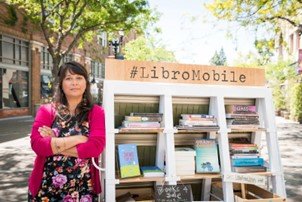
    Sarah Rafael García with #LibroMobile stand
    Sarah Rafael García with #LibroMobile stand

    As we organized into workgroups, we (Sarah Rafael Garcia, founder of LibroMobile Arts Cooperative and Dr. Jeremiah Sataraka at CSUB) found ourselves focused on Outreach and Internal Communications. We held a conversation with Dr. Jamila Moore Pewu convening host and Co-PI on the National Digital Ethnic Futures Consortium Grant and Dr. Ayana Jamieson, an assistant professor of Ethnic Studies at Cal Poly Pomona and founder and creative director of the Octavia E. Butler Legacy Network (OEBLEgacy).

    One thing we all agreed on is that the Digital Humanities is a community activity, and usually involves a great deal of collaboration and communication to assemble the relevant expertise for any given project. This led us to also counter some of the (aforementioned notions) historically white DH models in academic institutions and generalized terms like “community” that have been co-opted through white hierarchical processes in DH practices. The Digital Humanities does not require an academic degree, nor does it solely apply to the English language or institutions. DH has existed in various forms for decades, it is something grassroots organizers and Ethnic Studies educators have used to make social justice issues visible through digital platforms for advocacy and accountability.

    Recurring questions in our thread of ideas were: How will DH@CSU differ from other white-led DH departments and/or institutions? How will Ethnic Studies and BIPOC voices comprise and be centered as the foundation of the mission and ongoing goals?

    Although we initially tasked ourselves with answering these complicated questions, the only answer we could actually document was to build more visibility for people like us doing the work without institutional support or organized networks. Between all four of us, we have a list of DH projects in various stages and know there are more who deserve to be highlighted across the state.

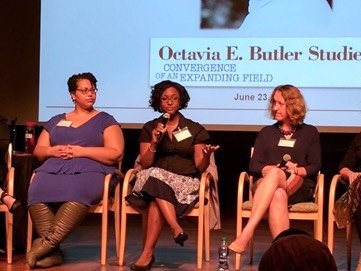
    Octavia E. Butler Studies Conference

    Ayana Jamieson was compelled to found Octavia E. Butler Legacy Network in 2009 after an embodied research visit to award-winning working-class speculative fiction author Octavia E. Butler’s final resting place in Altadena, California, way before the pandemic necessitated kinds of digital and remote work. During her dissertation research, OEBLegacy emerged from a vacuum of the field she coined “Octavia E. Butler Studies” and praxis of mapping Butler’s life and work across time and space with literal tours of psychological and geographical landscapes. Jamieson needed to reach out around Butler’s work in both virtual and physical spaces with labor done without the endorsement or support from any singular institution and required connecting with existing fans/activists/scholars/artists/everyday folks across the globe and doing what Dr. Alexis Pauline Gumbs calls community accountable scholarship. Eventually, Dr. Moya Bailey joined Jamieson as a #digitalalchemist for OEBLegacy which has always had the lived experience of marginalized folks centered intersecting Bailey’s work of coining “misogynoir” and enacting the “transformative magic of women of color online.”

    To date, OEBLegacy continues to do ethnic studies-centered work via ongoing projects with San Diego New Children’s Museum on the upcoming “Octavia E. Butler: Seeding Futures”  exhibit (2024 and beyond), ongoing projects with American Artist, writing or speaking for broad public audiences (The Feminist Wire, Public Books, Sierra Club Magazine, BILD, NPR , The New York Times and elsewhere). The work has been international and varied from editing special issues of academic journals to collaborative advising arts nonprofits and statewide humanities organizations to TedEd curriculum development to convening conferences at several places: “Ferguson is the Future” (2015) at Princeton University in collaboration with Bailey and sociologist Ruha Benjamin, “Octavia E. Butler Studies: Convergence of an Expanding Field” (2017) at the Huntington Library (where Butler’s papers are cataloged), and “Shaping Change: Remembering Octavia E. Butler through Archives, Art, and Worldmaking” (2016) in collaboration with literature and ethnic studies professor Dr. Shelley Streeby at UC San Diego.

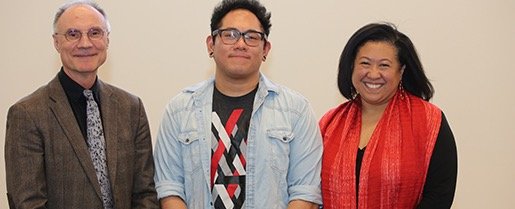
    Jeremiah Satarak group photo

    Jeremiah Sataraka’s introduction to the formal world of DH was back in 2019 when he was selected as a fellow for the Palouse Digital Scholarship Symposium. This was a week-long joint program hosted by Washington State University’s Center for Digital Scholarship and Curation and the University of Idaho’s Center for Digital Inquiry and Learning. Back then he was working on his dissertation research, which included documenting the oral histories and experiences of QTPIs (pronounced “cutie-pies”) Queer and/or Transgender Pacific Islanders, something he’s still working on today.

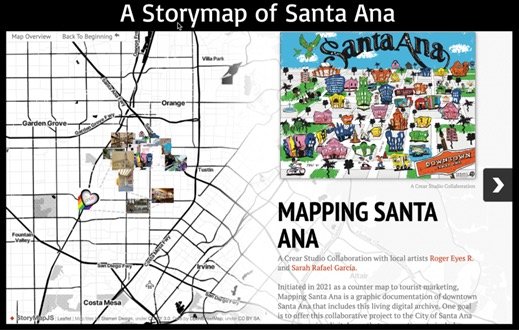
    Sarah Rafael García started exploring with DH before she knew it was a term. Her project SanTana’s Fairy Tales (awarded 2016-2017 in part by the Andy Warhol foundation), incorporated digital archives produced by a CSUF history student and the book is now an Ethnic Studies required text in the Santa Ana Unified School District. Soon after, she ventured into virtual timelines and DH research as a 2019 UH KGMCA Project Row Houses Fellow and 2020 US Latino Digital Humanities (USLDH) Grants-in-Aid program grantee, funded by the Mellon Foundation. Sarah Rafael received direct DH mentorship from Dr. Gabriela Dr. Baeza Ventura during both projects. Now, she has established the first for-and-by community-based Digital Archives project in Orange County via LibroMobile Arts Cooperative, which includes teaching community members how to preserve oral history and digitally archive familial albums and memorabilia. Through this work, she has also established Mapping Santa Ana and BIPOC Art Spaces, which aims to preserve BIPOC arts history in Orange County while building on anti-gentrification movement culture.

    Storymap of Santa Ana, CA
  • What Does It Mean to Build Digital Ethnic Futures?

    What Does It Mean to Build Digital Ethnic Futures?

    For the four regional public universities that serve as leaders in the new Digital Ethnic Futures Consortium (DEFCon), building digital ethnic futures means forming communities of practice, sharing knowledge and redistributing some zeros, about six to be exact.

    In September 2021, the Digital Ethnic Futures Consortium was established with support from a $3 million grant from The Andrew W. Mellon Foundation. The consortium, which operates on a hub-and-spoke model, includes an administrative hub at Salem State University, and three spokes at institutions across the U.S. including New Jersey City University, Texas Southern University and Cal State Fullerton.

    By Kendra Morales

    Read the full story from CSU Fullerton…

  • DH@CSU Receives DEFCon Award

    DH@CSU Receives DEFCon Award

    The Digital Humanities at California State University (DH@CSU) Consortium has received a 2023 Digital Ethnic Futures Consortium (DEFCon) award, supported by the Andrew W. Mellon Foundation, to build institutional capacity at the intersection of Digital Humanities and Ethnic Studies lead by Katherine D. Harris as Project Investigator (SJSU) and Jamila Moore Pewu as Co-PI of the national DEFCon initiative (CSU Fullerton). 

    The DH@CSU Consortium was formed by faculty across the CSU who have research and teaching interests in Digital Humanities, with the goal of fostering a system-wide collaboration of resources and expertise. It currently has members from seventeen of the twenty-three CSU campuses. In October 2022, DH@CSU Consortium members in the San Diego State University Library’s Digital Humanities Center and San José State University King Library’s Digital Humanities Center hosted the “Networked Connections: Explorations Across Digital Humanities,” which was part of the CUNY Digital Humanities Research Institute. 

    The DEFCon award represents the next step forward for DH@CSU members. With the commencement of the Ethnic Studies requirement in the General Education program, the DH@CSU Consortium is focusing on building a purposeful collaboration between Digital Humanities and Ethnic Studies. The Consortium is hopeful that Ethnic Studies’s embracing of community engagement and focus on underrepresented voices can be augmented and enhanced by the methodologies and approaches of Digital Humanities. The DEFCon award is an opportunity to explore this intersection, as it will allow the Consortium to expand membership by identifying additional Ethnic Studies faculty with interest in the Digital Humanities and create a network to connect them across disparate campuses. 

    As part of the grant’s activities, DH@CSU Consortium members will develop strategies for sharing infrastructure and resources, such as a virtual software lab, and will be able to access mentorship networks through the Digital Ethnic Futures Lab as part of Dartmouth’s Digital Humanities and Social Engagement Cluster. With the DEFCon award and additional mentorship, the DH@CSU Consortium will explore how to support resource-intensive Digital Humanities research projects and cultivate innovative teaching methods to imagine new approaches, courses, and programs in the CSU system. 

    Currently, DH@CSU Consortium members include: 

    • Armondo Collins, Assistant Professor of Composition, Rhetoric, and Literature, Department of English & Modern Languages, College of Letters, Arts and Social Sciences, Cal Poly Pomona 
    • Rob Lewis, Associate Professor of History, College of Letters, Arts and Social Sciences, Cal Poly Pomona 
    • Kate Ozment, Assistant Professor of English, Department of English & Modern Languages, College of Letters, Arts and Social Sciences, Cal Poly Pomona 
    • Kristin Prins, Associate Professor of Composition and Rhetoric, Department of English & Modern Languages, Colleges of Letters, Arts & Social Sciences, Cal Poly Pomona 
    • Isaac Schankler, Assistant Professor of Music, College of Letters, Arts and Social Sciences, Cal Poly Pomona 
    • Theresa Avila, Curator of the Art Program, School of Arts and Sciences, CSU Channel Islands 
    • Annemarie Perez, Assistant Professor of Interdisciplinary Studies, College of Arts and Humanities, CSU Dominguez Hills 
    • Colleen Greene, Digital Literacy Librarian, Pollak Library, CSU Fullerton 
    • Jamila Moore Pewu, CSUF DEFCon Director, and Assistant Professor of Digital Humanities and New Media in History, CSU Fullerton 
    • Scott Kleinman, Director, Center for the Digital Humanities,CSU Northridge 
    • Danielle Spratt, Associate Professor of English, College of Humanities, CSU Northridge 
    • Christina Acosta, Lecturer of Ethnic Studies, College of the Arts, Humanities & Social Sciences, CSU Stanislaus 
    • Sureshi M. Jayawardene, Associate Professor of Africana Studies, College of Arts and Letters, San Diego State 
    • Pamella Lach, Digital Humanities Librarian, DH Center Director, DH Initiative Co-director, San Diego State 
    • Jessica Pressman, Professor of English and Comparative Literature, College of Arts and Letters, San Diego State 
    • Katherine D. Harris, Director of Public Programming, College of Humanities & the Arts; Professor of Literature & Digital Humanities @ San José State  – Project Investigator
    • Christina Mune, Associate Dean of Innovation & Resource Management, King Library @ San José State 
    • Nick Szydlowski, Digital Scholarship Librarian, King Library @ San José State 

    For a full list of each campus represented on the Steering Committee, please see People.

    Interested faculty, staff, and administrators are welcome to reach out to their campus’s consortium member or to our DH@CSU contact person, Dr. Katherine D. Harris at katherine.harris@sjsu.edu. 

    Updated 11/18/23